 Spanish
 English
 French

Understanding pilot-operated pressure regulation, its advantages, and when to consider it for your application.
Maintaining consistent downstream gas pressure isn’t always straightforward, especially when inlet pressures fluctuate, flow demands change, or applications require precise pressure control.
That’s where pilot-operated gas pressure regulators come into play.
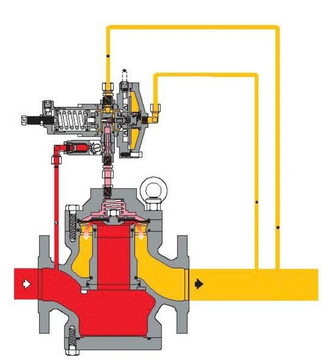
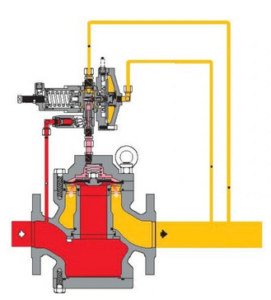 Unlike regulators that rely solely on direct mechanical action to control pressure, pilot-operated regulators use system pressure and a separate pilot control circuit to adjust the main regulator’s position. This arrangement allows the regulator to respond to changing operating conditions while maintaining the desired outlet pressure.
But how exactly does that work?
What Is a Pilot-Operated Gas Regulator?
A pilot-operated gas regulator is a pressure control device that uses a smaller regulator, called a pilot, to control the operation of a larger main regulator.
The pilot continuously senses downstream pressure and adjusts the control pressure acting on the main regulator. In response, the main regulator changes its position to regulate gas flow and maintain the desired outlet pressure.
The key difference is that the pilot controls the main regulator, while the main regulator controls the gas flow.
This configuration is particularly useful in applications where pressure accuracy and responsiveness are important across varying operating conditions.
How a Pilot-Operated Regulator Works: Four Key Steps
Although pilot-operated regulators can vary in design and configuration, the fundamental operating principle follows four steps.
Step 1: Inlet Pressure Supplies the System
Gas enters the main regulator through the inlet connection.
A portion of that inlet pressure is also directed through a pilot feed line, supplying the pressure energy needed to operate the pilot control system.
This allows the regulator to use the pressure already available within the system to control its operation.
Step 2: The Pilot Senses Outlet Pressure
The pilot monitors downstream (outlet) pressure and compares it to the desired pressure setpoint.
As operating conditions change, the pilot senses deviations from that setpoint.
For example, when downstream gas demand increases, outlet pressure may begin to decrease. Conversely, when demand decreases, downstream pressure may begin to rise.
The pilot detects these changes and responds accordingly.
Step 3: The Pilot Adjusts Control Pressure
Based on the downstream pressure reading, the pilot increases or decreases the control pressure supplied to the main regulator.
This is an important distinction: the pilot isn’t directly controlling the full volume of gas flowing through the pipeline.
Instead, it regulates the pressure that determines how the main regulator responds.
Step 4: The Main Regulator Controls Gas Flow
The main regulator responds to changes in control pressure by adjusting its position.
As demand increases or decreases, the main regulator changes the amount of gas flowing through the valve to help maintain the desired outlet pressure.
This continuous interaction between the pilot and main regulator allows the system to respond to changes in demand and inlet pressure.
The result is controlled downstream pressure, even as operating conditions change.
[Insert original ECCO “How a Pilot-Operated Regulator Works” diagram here. The illustration identifies the pilot feed line, downstream sensing connection, control circuit, and main regulator.]
What Are the Advantages of Pilot-Operated Gas Regulators?
Pilot-operated regulators offer several performance advantages that make them well-suited for applications requiring accurate pressure regulation.
1. Precise Downstream Pressure Control
Because the pilot continuously monitors outlet pressure and adjusts the main regulator, pilot-operated systems can provide accurate pressure control under changing operating conditions.
2. Responsive to Changing Flow Demand
Gas demand isn’t always constant. Industrial processes, large commercial equipment, and gas distribution systems can experience significant variations in flow.
Pilot-operated regulators are designed to respond to these changes, adjusting the main valve to maintain the required downstream pressure.
3. High Flow Capacity
Pilot-operated designs can be particularly useful in higher-capacity applications where the main regulator must control substantial gas flow.
Rather than relying solely on a spring and diaphragm to position the main valve, the regulator uses system pressure to assist with control.
4. Performance Across Varying Inlet Conditions
Changes in upstream pressure can influence regulator performance.
A properly selected pilot-operated regulator can help maintain consistent downstream pressure as inlet conditions fluctuate within its specified operating range.
Pilot-Operated vs. Direct-Acting Regulators: What’s the Difference?
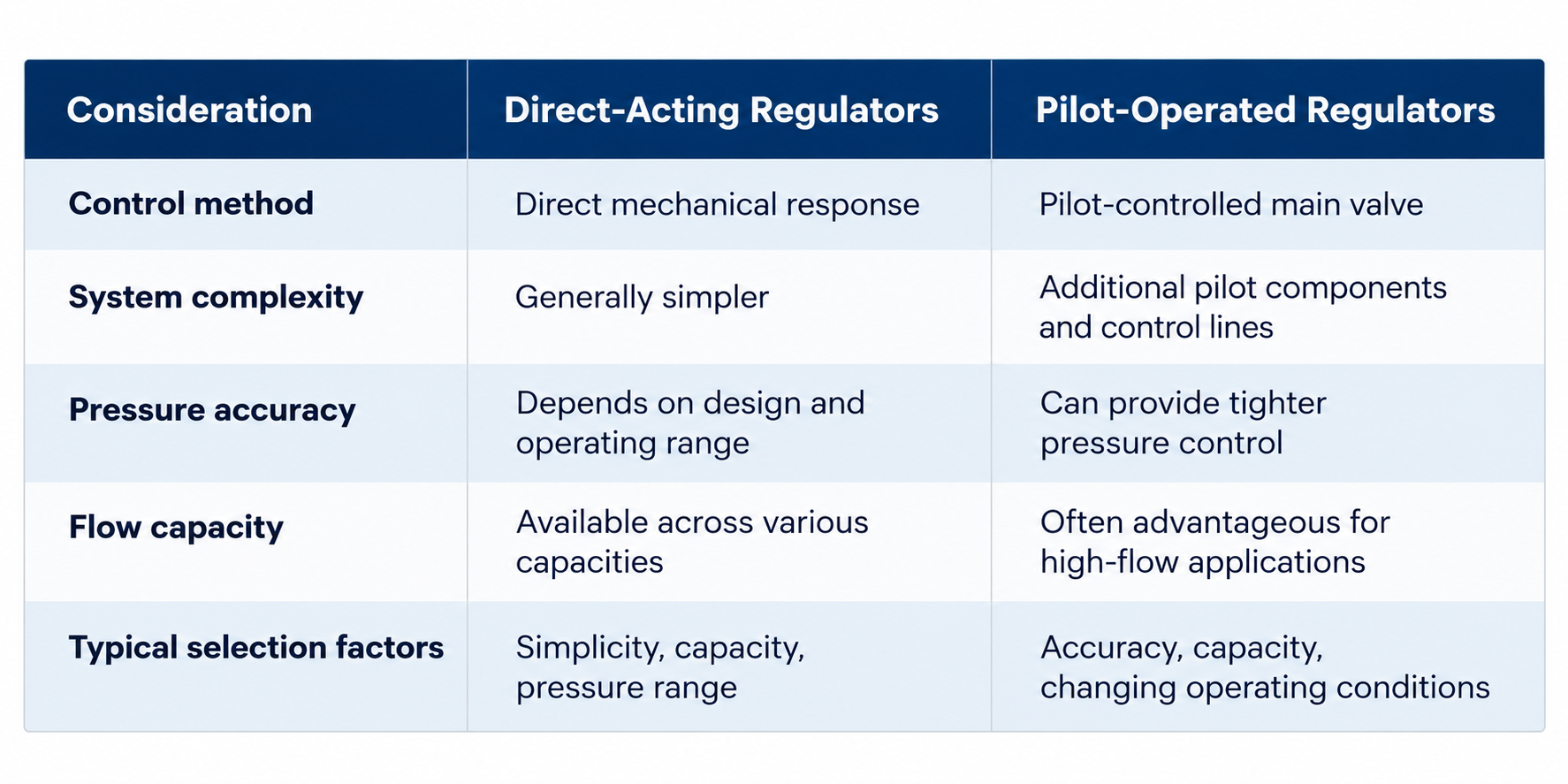
Both pilot-operated and direct-acting regulators are designed to control downstream pressure, but they accomplish that task differently.
Direct-acting regulators use a spring, diaphragm, and valve mechanism to respond directly to downstream pressure changes. They typically have fewer control components and can be well-suited for a wide range of low- and medium-pressure applications.
Pilot-operated regulators use a separate pilot control circuit to adjust the main regulator’s position. This arrangement can offer advantages in pressure accuracy, flow capacity, and responsiveness, depending on the application and regulator design.
Neither approach is universally better. The right selection depends on the operating requirements of the system.
What Should You Consider When Selecting a Pilot-Operated Regulator?
Understanding how a pilot-operated regulator works is only part of the equation. Proper selection and sizing are equally important.
Before selecting a regulator, consider these operating requirements:
- Inlet pressure: What are the minimum and maximum upstream pressures the regulator will encounter?
- Required outlet pressure: What downstream pressure must the regulator maintain?
- Flow demand: What are the minimum, normal, and maximum flow requirements?
- Operating conditions: How frequently and significantly will demand or inlet pressure change?
- Gas characteristics: What type of gas will the regulator control?
- System configuration: What are the piping arrangements, installation requirements, and available space?
- Overpressure protection: What protection is required for the downstream system?
It’s also important to evaluate the entire operating range rather than sizing a regulator based only on maximum flow.
A regulator must perform appropriately at both high and low demand to provide reliable pressure control.
Explore Pilot-Operated Gas Regulators from ECCO
Equipment Controls Company offers a range of Pietro Fiorentini pilot-operated gas pressure regulators for various pressure control applications.
Reflujo PF 819
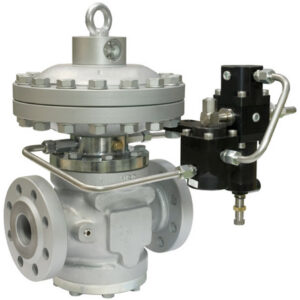
El Reflujo PF 819 is a pilot-operated gas pressure regulator designed for medium- and high-pressure applications, including natural gas transmission, distribution, power generation, and industrial use. Featuring high outlet pressure accuracy, a 1,000:1 turndown ratio, and a balanced valve design, it responds quickly to changing flow demands. Its fail-to-close configuration and top-entry design allow for maintenance without removing the regulator body from the pipeline.
PF Aperflux 851

El PF Aperflux 851 is a pilot-operated gas pressure regulator designed for medium- and high-pressure applications, including natural gas distribution and commercial and industrial supply networks. Featuring high outlet pressure accuracy, a wide operating range, and fast response to changing flow demands, it delivers reliable pressure control under varying conditions. Its fail-to-open configuration and top-entry design allow for maintenance without removing the regulator body from the pipeline.
PF Aperflux 101

El Aperflux 101 is a boot style pilot-controlled pressure regulator for medium and high pressure applications. Aperflux 101 is normally a failed open regulator and specifically will open under the following circumstances:
• Rotura del diafragma principal;
• Falta de presión en la alimentación del circuito piloto;
Estos reguladores son adecuados para su uso con gases no corrosivos previamente filtrados.
PF Aperval 101
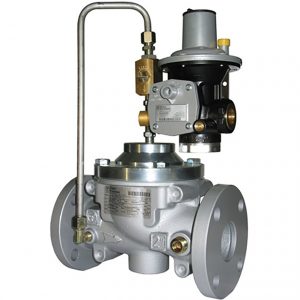
Se abrirá si:
• No hay suministro de bucle piloto;
• El diafragma del piloto principal está dañado.
Este regulador es adecuado para su uso con gases no corrosivos previamente filtrados.
Each regulator has its own operating characteristics, pressure ranges, capacity specifications, and configuration options. Reviewing those requirements against actual system conditions is essential to selecting the appropriate solution.
Have Questions About Pilot-Operated Regulators? Ask ECCO.
Understanding how a regulator operates is the first step. Knowing which regulator is right for a particular application requires looking at the entire system.
From regulator selection and sizing to understanding pressure control and operating requirements, ECCO’s technical team helps engineers, utilities, contractors, and other natural gas professionals work through their application needs.
ECCO also offers complimentary technical training programs covering gas regulation fundamentals, regulator operation, and other important industry topics.
Have a question about pilot-operated regulators or need help evaluating an application? Contact ECCO to connect with our team.
